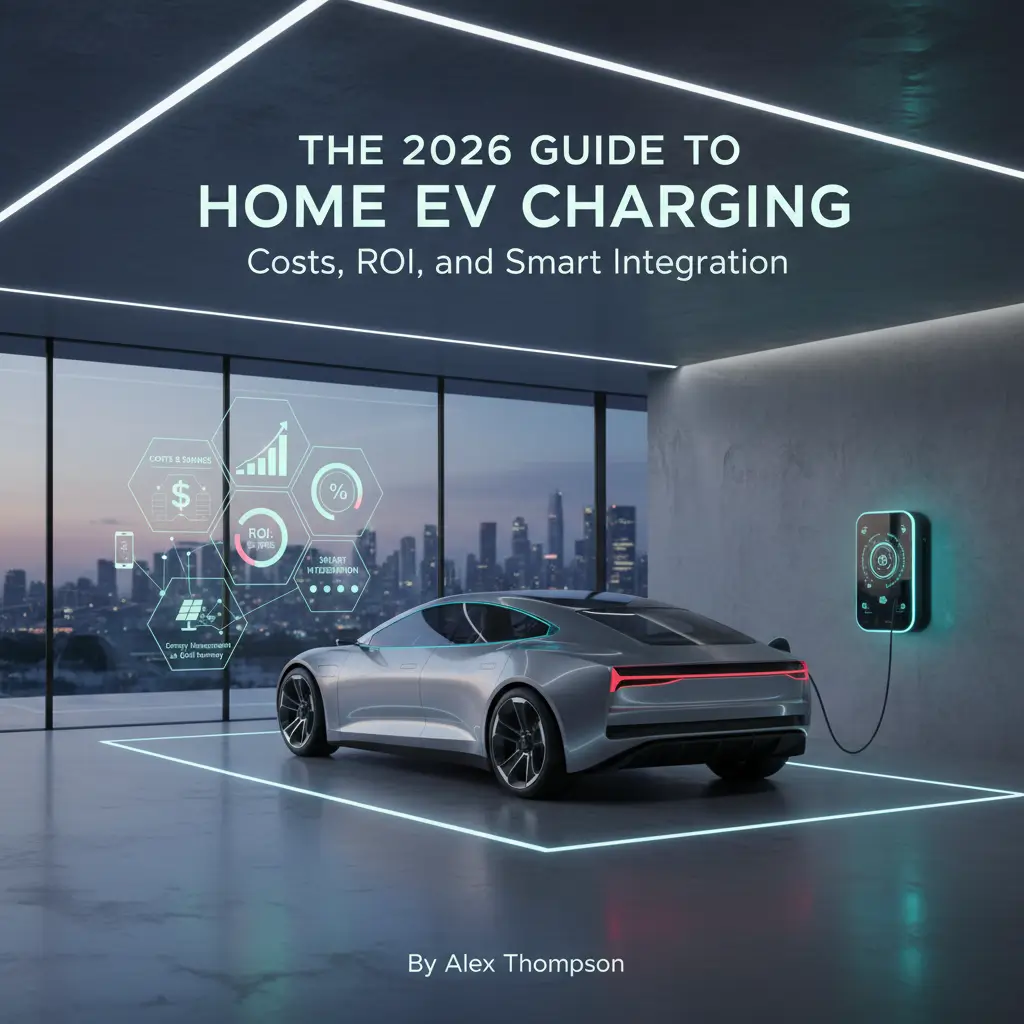

The convenience of waking up every morning to a “full tank” is the primary reason homeowners are flocking to residential charging solutions. In 2026, with the expansion of high-speed fiber internet and smart grid technology, the home charger has become an integrated part of the Smart Home Ecosystem.
1. Understanding the Levels: Why Level 2 is the Standard
To understand the value of a home installation, we must first distinguish between the three levels of charging available in 2026:
- Level 1 (The Emergency Backup): This uses a standard 120V household outlet. It is painfully slow, adding only about 3–5 miles of range per hour. For a modern EV with a 300-mile battery, a full charge could take over four days.
- Level 2 (The Residential Standard): Operating on a 240V circuit (similar to a clothes dryer), Level 2 chargers provide 20–50 miles of range per hour. This allows for a complete overnight charge for even the largest battery packs.
- Level 3 (DC Fast Charging): These are the industrial-grade chargers found at highway rest stops. Due to massive power requirements and equipment costs exceeding $30,000, these are not viable for residential use.
2. The Real Cost of Installation in 2026
Budgeting for an EV charger involves two distinct costs: the hardware (the charger itself) and the professional installation.
Hardware Costs ($400 – $1,200)
In 2026, you aren’t just buying a plug; you are buying a smart appliance. High-end units like the ChargePoint Home Flex or Wallbox Pulsar Max now include:
- Wi-Fi Connectivity: For remote monitoring and firmware updates.
- Load Balancing: The ability to share power with other appliances to prevent tripping the main breaker.
- Bi-directional Readiness: Some 2026 models are “V2H” (Vehicle-to-Home) ready, meaning your car can power your house during a blackout.
Labor and Electrical Costs ($600 – $2,500)
The complexity of your home’s electrical panel determines this price.
- Simple Install: If your panel is in the garage and has extra capacity, a licensed electrician can install a new 50-amp circuit for roughly $600–$900.
- Complex Install: If your panel is across the house, or if your home requires a Service Upgrade (moving from 100-amp to 200-amp service), costs can escalate to $2,500 or more.
3. The Financial ROI: How Charging at Home Pays You Back
The “Return on Investment” for an EV charger comes from three specific areas: fuel savings, property value, and tax incentives.
The Fuel Savings Gap
Public charging stations in 2026 often charge a premium for convenience, sometimes costing $0.45 to $0.70 per kWh. In contrast, the average residential rate is roughly $0.16 per kWh.
The Math: If you drive 12,000 miles a year, home charging will save you approximately $1,200 to $1,800 annually compared to using public fast chargers.
Real Estate Appreciation
In the 2026 real estate market, an “EV-Ready” garage is the new “Granite Countertop.” Studies show that homes with pre-installed Level 2 chargers sell for an average of 3.1% more (roughly $15,000 on a $500,000 home) than those without. For many buyers, the absence of a charger is now a “deal-breaker.”
4. Maximizing the 2026 Tax Credits
The “Alternative Fuel Vehicle Refueling Property Credit” remains a powerful tool for 2026 homeowners.
- The Federal Credit: You can claim 30% of the total cost (hardware + labor), up to a maximum of $1,000.
- Local Utility Rebates: Many power companies now offer “Instant Rebates” of $200–$500 if you agree to use a “Smart Charger” that allows them to throttle charging during extreme grid emergencies.
5. Technical Requirements: What Your Electrician Needs to Know
Before you buy a charger, you must verify your home’s “Electrical Health.”
- Panel Capacity: Most Level 2 chargers require a dedicated 40-amp or 50-amp breaker. If your panel is full, you may need a “Sub-panel.”
- Permitting: In 2026, local municipalities have streamlined the process, but an electrical permit is still required to ensure the installation meets the National Electrical Code (NEC).
- Cable Management: Ensure the charger is placed within 20 feet of where your car’s charging port will be parked. Modern cables are heavy; high-quality retractable mounts are a recommended “quality of life” upgrade.
6. Smart Charging and the 2026 Grid
The most advanced feature of 2026 chargers is Managed Charging. Through an app, you can set your car to only charge when the grid is “Greenest” (using solar or wind) or when prices are at their “Super Off-Peak” lows (often 2:00 AM to 5:00 AM).
By syncing your charger with a Home Energy Monitor, you can ensure your car never charges while the electric oven and clothes dryer are running, preventing unnecessary stress on your home’s wiring.
Final Thoughts: Is It Worth the Investment?
As we look at the trajectory of the automotive industry in 2026, the transition to electric is inevitable. Installing a home charger is no longer a luxury for early adopters; it is a fundamental home improvement that offers immediate utility, long-term fuel savings, and a significant boost to your home’s equity.
If you plan on owning an EV for more than two years, a Level 2 home station isn’t just an expense—it’s an investment that pays for itself in convenience alone.