
1. What Exactly is a Virtual Power Plant?
To understand the VPP, you must first understand the “Peaker Plant” crisis. Historically, when temperatures soared during summer heatwaves, the grid would struggle to meet the sudden surge in air conditioning demand. To prevent blackouts, utilities had to fire up “Peaker Plants”—expensive, high-emission gas plants that only ran a few days a year but cost billions to maintain.
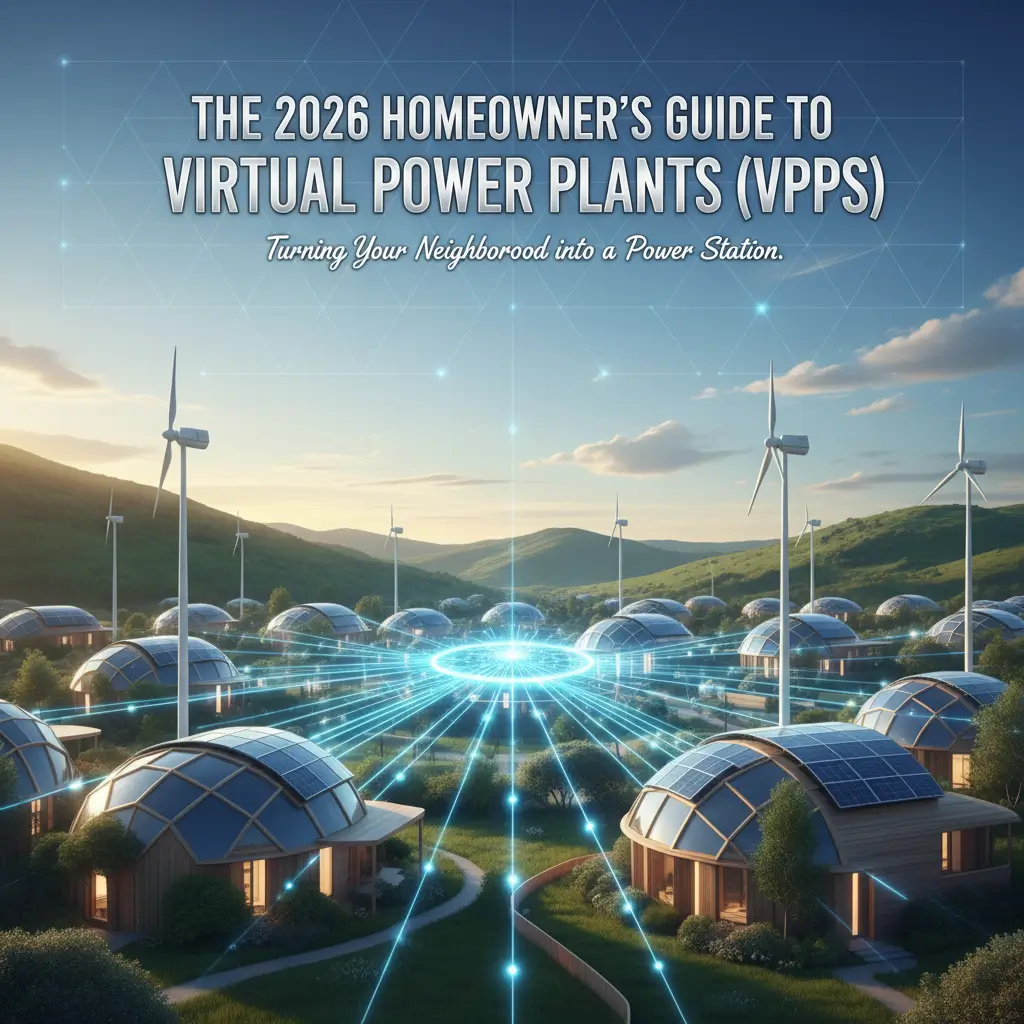
In 2026, we have a smarter solution. Instead of building a new polluting plant, the utility company “borrows” a tiny amount of energy from 10,000 home batteries simultaneously.
The Coordination Engine
By using Agentic AI and high-speed fiber communication, a VPP operator can coordinate these thousands of small discharges to create a massive “surge” of power that stabilizes the grid. To the utility, this “virtual” plant is just as reliable as a coal or nuclear station, but because it is located exactly where the electricity is needed (your neighborhood), it avoids the energy losses associated with long-distance transmission.
2. The Revenue Model: How Much Can You Actually Earn?
In 2026, joining a VPP (offered by industry leaders like Tesla, Sunrun, or new players like Kora Energy) has become a primary source of passive income. The financial structure of a VPP is typically “stacked,” meaning you earn from multiple streams at once.+1
Performance Payments (The “Retainer” Model)
Most VPP providers offer a guaranteed annual payment simply for being “on-call.” In 2026, these flat rates have stabilized between $500 and $1,200 per year. You receive this money regardless of whether the grid actually needs your power; it is a payment for the availability of your capacity.
Event-Based Credits (The “Spot Market” Payday)
During extreme “Grid Stress Events”—such as an unexpected cold snap or a localized equipment failure—the VPP operator will call for a discharge. Because these are “emergency” situations, the compensation is astronomical.
- The 2026 Rate: While your standard electricity might cost $0.15 per kWh, VPP event credits are often priced at “Spot Market” rates, sometimes exceeding $1.00 per kWh.
- The Payout: Homeowners in high-demand zones like California, Texas, and New South Wales report earning $15 to $30 in a single afternoon during a summer peak.
FCAS: The Hidden Goldmine
Frequency Control Ancillary Services (FCAS) is the most sophisticated way to earn in 2026. The grid must stay at an exact frequency (60Hz or 50Hz) to prevent damage to appliances. Your smart battery can respond in milliseconds to tiny fluctuations, absorbing or releasing tiny bursts of power. You earn “micro-credits” every hour of the day for this service, which can add an additional $200–$400 to your annual total.
3. V2G (Vehicle-to-Grid): Your Car as a Mobile Generator
The biggest “power player” in the 2026 VPP landscape isn’t the battery on your wall—it’s the one in your driveway. Vehicle-to-Grid (V2G) technology, recently made affordable by manufacturers like Nissan, Ford, and Hyundai, allows your EV to act as a massive backup for the city.
- The Scale: A typical home battery holds roughly 13.5 kWh. A modern EV battery holds between 75 and 130 kWh.
- The Profit Potential: Your car is essentially ten home batteries on wheels. By participating in a V2G VPP program while your car is parked at home or work, you can “sell” your excess capacity. In 2026, savvy EV owners are using V2G income to effectively negate their monthly car payment, turning a depreciating asset into a revenue-generating node.
4. Is it Safe for Your Equipment? (The Degradation Myth)
A common concern for homeowners entering the VPP market is whether constant “cycling” will kill their battery. In 2026, this concern has been addressed by both technology and policy.
AI-Driven Health Management
Modern VPP software is “Degradation Aware.” The AI algorithms ensure that the grid only draws power when it won’t harm the long-term health of your Lithium-Iron-Phosphate (LFP) cells. These batteries are rated for 6,000 to 10,000 cycles, and VPP participation typically accounts for less than 5% of that total wear.
Warranty Standards
Following the National Smart Grid Act, most battery manufacturers now include “VPP-Approved” clauses in their warranties. In fact, many 2026 warranties actually require participation in an authorized VPP, as the constant software monitoring ensures the battery is being operated in its “Goldilocks Zone” of temperature and charge.
5. How to Join a VPP in 2026: A Step-by-Step Guide
Joining a VPP has been streamlined into a process that takes less than five minutes through your smartphone.
- Check Compatibility: Ensure your inverter and battery are “VPP-Ready.” Since 2024, almost all Tier-1 systems (Tesla Powerwall 3, Enphase IQ 5P, SolarEdge Home) come with integrated VPP communication hardware.
- Select a Provider: You can choose between your utility’s direct program (like the Duke Energy “Smart Connect”) or an independent aggregator who might offer higher “Spot Market” returns.
- Set Your “Reserve”: This is the most important step. You always maintain control. You can tell the VPP: “Never let my battery drop below 30%.” This ensures that even if the grid is in a state of emergency, your home will always have enough power for your own lights, fridge, and Wi-Fi.
- Automate and Earn: Once set up, the system runs in the background. You will receive monthly or quarterly “Energy Dividends” directly to your bank account or as a credit on your utility bill.+1
The Bottom Line: The House That Pays for Itself
In 2026, the “Smart Home” has reached its final form. It is no longer just a place that is “connected”—it is a place that is productive. Virtual Power Plants represent the ultimate ROI for renewable energy. You aren’t just saving money on your own bill; you are being paid to keep the lights on for your entire community.
As global energy demand continues to rise, the value of your stored home energy will only increase. By turning your neighborhood into a power station, you are securing your financial future while leading the charge toward a cleaner, more resilient world.