
Heating and cooling remain the single largest energy expense for residential properties, often accounting for 40% to 60% of a monthly utility bill. In previous years, we tried to solve this with better insulation or more efficient compressors. In 2026, we are solving it with Intelligence.
1. What is “Agentic AI” in HVAC?
The term “Smart Thermostat” is being replaced in 2026 by “Autonomous Climate Managers.” Unlike the smart thermostats of 2020, which required you to set a schedule, Agentic AI uses machine learning to make decisions on your behalf.
- Occupancy Synthesis: Using a combination of geofencing (tracking your phone’s location) and ultra-wideband (UWB) sensors within the house, the system knows exactly which rooms are occupied. It doesn’t just “turn off” when you leave the house; it prepares the home for your return based on your distance and current traffic patterns.
- Thermal Modeling: The AI creates a “Digital Twin” of your home’s thermal performance. It learns that your south-facing living room heats up 40% faster than your north-facing office and adjusts the variable-speed blower accordingly.
- Dynamic Rate Response: In 2026, AI HVAC systems communicate directly with your utility provider’s API. If the price of electricity is set to spike at 4:00 PM, the AI will “pre-cool” your home at 2:30 PM while rates are low, then go into a low-power “drift” mode during the expensive peak hours.
2. The Hardware: Variable-Speed and Inverter Technology
To truly benefit from AI software, you need hardware that can handle precision. The standard in 2026 has moved to Inverter-Driven Compressors.
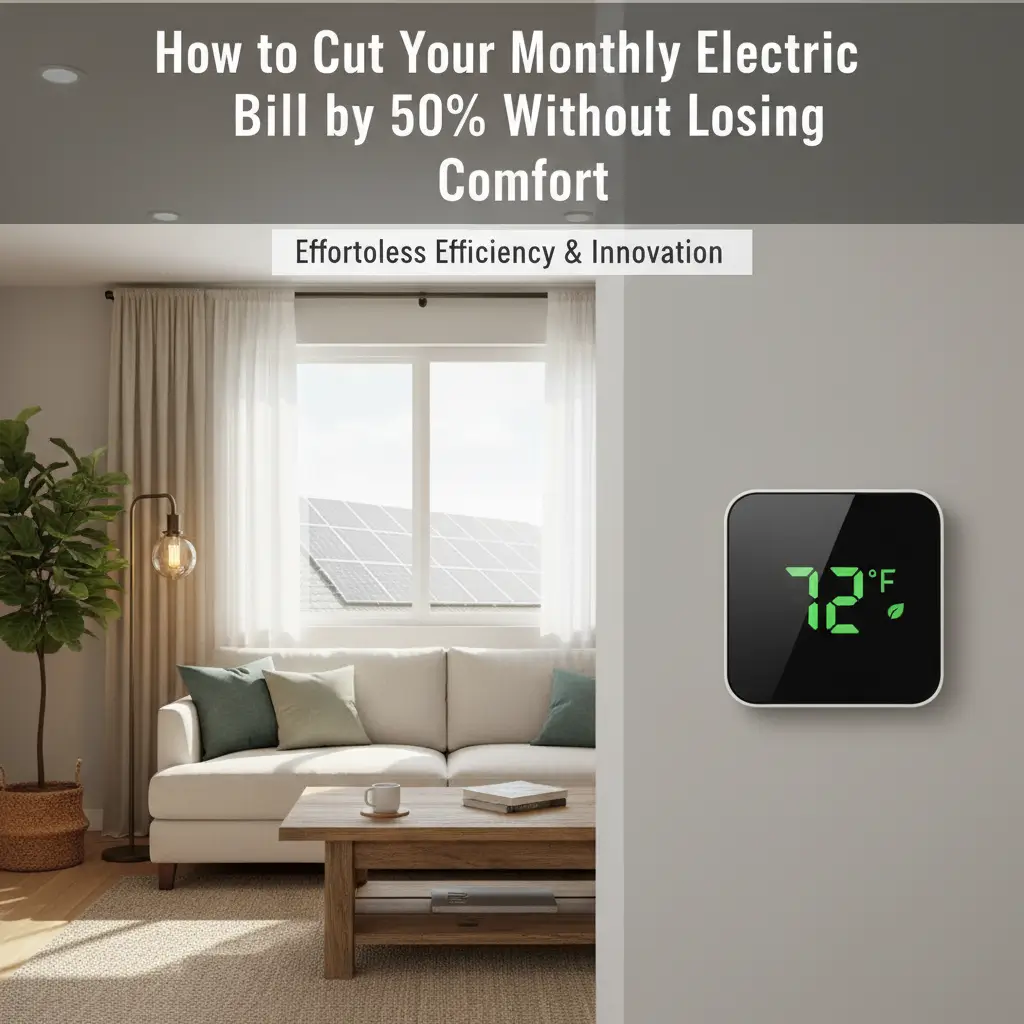
Traditional HVAC systems are binary—they are either 100% on or 100% off. This creates “temperature swings” and high energy surges. Modern inverter systems can run at as little as 10% capacity. The AI acts as the conductor, telling the inverter to run at exactly 32% power to maintain a perfect 72°F (22°C) without the energy-intensive “startup surge” of older models.
3. Smart Vents and Zonal Intelligence
A major breakthrough in 2026 is the widespread adoption of AI-Controlled Smart Vents.
The Problem: In a traditional home, the AC cools the whole house, even if you are only in the bedroom. This is like leaving every light in the house on just to read a book in the den. The 2026 Solution: Systems like Flair or Keen use AI to open and close individual vents. If the AI detects that the upstairs guest room is empty, it physically closes those vents and redirects that “pressure” to the rooms you are actually using. This “zonal focusing” can reduce HVAC runtime by up to 30%.
4. Predictive Maintenance: Stopping $5,000 Failures for $50
In 2026, the most valuable feature of a smart HVAC system is its ability to “predict the future.” Through Vibration and Acoustic Analysis, AI sensors can listen to the sound of your motor and the rhythm of your compressor.
- Anomaly Detection: If a bearing in your blower motor starts to wear down, it creates a microscopic vibration pattern. The AI detects this weeks before the motor actually fails.
- The ROI: Instead of a $1,000 emergency repair on a Sunday night, the system sends a notification to your phone: “Blower motor wear detected. Schedule a $150 proactive replacement to avoid mid-summer failure.”
5. Health and Indoor Air Quality (IAQ)
AI is also taking over the “Health” of your air. In 2026, whole-home air purifiers are integrated directly into the HVAC stack.
- Pollutant Spikes: If you are cooking and the IAQ sensors detect a spike in PM2.5 (particulate matter) or VOCs, the AI automatically ramps up the filtration system and increases the “fresh air intake” from the Heat Recovery Ventilator (HRV).
- Humidity Management: AI now manages humidity as a function of “perceived temperature.” By lowering the humidity by 10%, the AI can make 75°F feel like 72°F, allowing you to save energy without feeling the heat.
6. Financial Incentives and Tax Credits in 2026
Upgrading to an AI-managed system is heavily subsidized in 2026:
- Energy Star 4.0 Rebates: Many local utilities offer instant rebates of up to $2,000 for variable-speed heat pumps with AI-enabled demand response.
- 25C Tax Credit: In the U.S., homeowners can still claim up to $2,000 per year for high-efficiency heat pump installations under the expanded “Residential Energy Efficiency” credits.
[Table: 2026 Smart HVAC Savings Breakdown] | Feature | Annual Savings Potential | Primary Benefit | | :— | :— | :— | | AI Demand Response | $150 – $400 | Shifts usage to off-peak hours | | Smart Zonal Venting | $200 – $600 | Only cools/heats occupied rooms | | Inverter Efficiency | $300 – $800 | Eliminates energy-heavy “start-stops” | | Predictive Repair | $500 – $2,000 | Avoids emergency call-outs and total system failure |
Final Thoughts: The House That Thinks
The HVAC system of 2026 is no longer a hidden box in the attic; it is the “lungs and brain” of the home. By moving from reactive cooling to Predictive Climate Management, you aren’t just saving money—you are increasing the lifespan of your equipment and ensuring your family breathes the cleanest air possible. In the high-stakes world of 2026 real estate, an AI-managed HVAC system is the ultimate proof of a future-proof home.